This guide will help you to know what to expect as you work with your healthcare team to manage and treat a ganglion cyst on your hand or wrist.
Any new lump or bump on your body should be checked by a healthcare provider. This pathway is for anyone who has been diagnosed with a ganglion cyst on their hand or wrist.
You will have your own unique journey with ganglion cysts. How you move through your journey, the number of visits with your healthcare team, the steps you will take, and the order you take them in will depend on your needs. You will make decisions in partnership with your healthcare team. Always follow your healthcare team’s advice.
What is a ganglion cyst?
A ganglion cyst is a small sac that is filled with a jelly-like fluid. They usually appear as round, smooth, firm, rubbery, and slightly moveable bumps below the skin. Ganglion cysts are not cancerous.
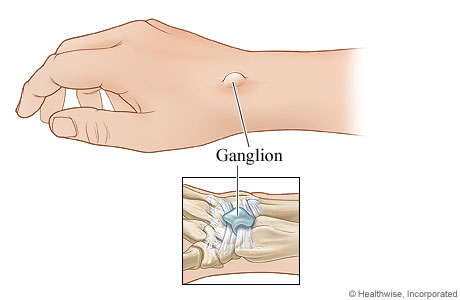
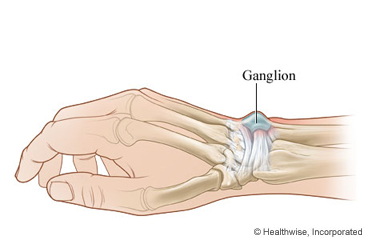
Ganglion cysts are most common on the hands and wrists. They can occur in different places, like the back of the wrist (this is the most common place), palm side of the wrist, base of a finger, or close to the fingernail. They can also grow on other parts of your body, like your feet, ankles, knees, or shoulders.
Ganglion cysts usually go away on their own and do not need treatment. More than half of ganglion cysts go away on their own within a year.
Ganglion cysts:
- appear suddenly
- can be very small or can get bigger than a cherry
- can be present for months to years
- can sometimes get bigger (fluid can build up in the sac) as you do certain activities
- are usually painless, so talk to your healthcare provider if you notice pain or if the ganglion cyst impacts how you can use and move your hands and wrists
A common type of ganglion cyst is called a mucous cyst. These are associated with osteoarthritis in the fingers. Mucous cysts usually occur in the joint closest to the fingernail.
Anyone can get a ganglion cyst, but they are not usually seen in children. They are more common if you are female and young to middle-aged. Having a history of hand and wrist injuries or using your hands and wrists a lot in a repetitive way (like for some sports, work activities, or hobbies) can also increase your risk of getting a ganglion cyst.
Whole-person health
The whole-person health approach will help you and your healthcare team better manage your health condition.
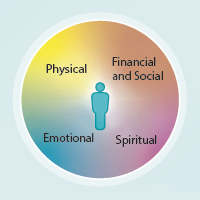
Whole-person health draws from the teachings of the medicine wheel. It means thinking about all parts of your health and wellness:
- physical
- financial and social
- spiritual
- emotional
These parts are all connected and impact each other. It’s important to be aware of your personal needs in each part and to share that information with your healthcare team. Your healthcare team needs to understand who you are and what matters to you. Here are some examples of things you may want to talk about with your healthcare provider:
- “My symptoms are making it hard for me to do my job.” (physical)
- “If I need surgery, will I need to miss any work as I recover?” (financial and social)
- “I need my daughter with me as a translator.” (financial and social)
- “I do not like the look of the ganglion cyst on my wrist.” (emotional)
Support and resources
- If you need a family doctor or clinic accepting new patients near you, visit
Alberta Find a Provider.
- If you need a translator, let your healthcare provider know.
- If you need health advice any time, day or night, call Health Link at 811.
- If you need to find programs and services in your community, call or text 211 or visit
211 Alberta.
For more information about perianal disease, visit the
Canadian Digestive Health Foundation.
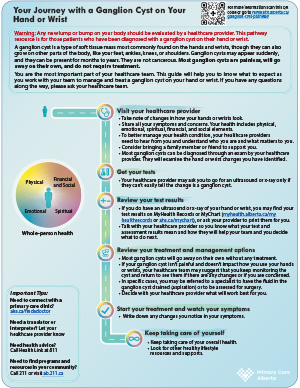
Ganglion Cyst Pathway
Download or print the
full patient pathway (PDF) and
summary (one-page PDF) to learn more about how to prevent, manage, and treat ganglion cyst problems.
Patient Pathway  Summary