Understanding your child’s communication, social development, and early signs of autism
This resource is designed to help parents and caregivers of babies and young children who may be experiencing developmental delays in social interactions or communication. This resource also acts as a guide for caregivers to understand what to expect if their child is showing early signs of autism.
Every family is unique and your family’s culture, experiences, and traditions matter. Use this pathway as a starting point and adapt it in ways that work best for you and your family. You will make decisions in partnership with your child’s healthcare team. Always follow your healthcare team’s advice.
Language
This pathway uses 2 types of language to respect the opinions of all people with autism and their families. If you prefer a style of language, please discuss this with your healthcare team and others in your life, so they can best support you.
-
Person-first language puts the person before the condition. It reminds us that each person is more than their diagnosis and helps show respect and inclusion. Example: a child with autism.
-
Identity-first language puts the condition first. It shows that autism is an important part of who someone is. This is often used by people who speak for themselves and when shorter wording is helpful. Example: “autistic child.”
What is autism?
A note for parents and caregivers:
This can be a lot. It’s OK not to do everything at once. Take steps that feel right for you and your family, at a pace that works for you.
Autism is a condition that affects how a person’s brain develops and works. Autistic children often face challenges with communication, social interactions, and may repeat certain actions and behaviours. Autism affects the whole family, including parents, siblings, grandparents, and caregivers.
Autism is referred to as spectrum because it looks different for each child. Some children have mild signs, while others have more noticeable challenges. Because each child is different and every family is different, each autistic child needs different kinds of help and support.
An early diagnosis of autism can open doors to different resources that are important for some children and families. If your child shows signs of autism, it’s your choice to get a diagnosis and you decide when. Many types of support, like pediatric community rehabilitation, will be helpful with or without an autism diagnosis.
Whole-person health
The whole-family health approach will help you balance the overall needs of your family, while addressing the questions or concerns you have about your child’s development.
Whole-family health means thinking about all parts of your family’s health and wellness:
- physical
- financial
- social
- spiritual
- emotional
- environmental
These parts are connected and influence each other. It’s important to be aware of your personal needs, and your family’s needs in each part and to share that information with your child’s healthcare team:
- “I am tired all the time from trying to help my child cope.” (physical)
- “It’s really expensive to pay for therapy sessions and travel to appointments.” (financial)
- “I can’t find childcare to look after my children.” (social)
- “It is important that our cultural, religious, or traditional practices be respected in my child’s care.” (spiritual)
- “My family is overwhelmed and I’m not sure how to manage it.” (emotional)
- “We avoid crowded spaces because my child is highly sensitive to noise.” (environmental)
Support and resources
- If your child needs a family doctor or clinic accepting new patients near you, visit
Alberta Find a Provider.
- If you need an interpreter or translator, let your healthcare provider know.
- If you need health advice any time, day or night, call Health Link at 811.
- If you need to find programs and services for your child in your community, call or text 211 or visit
211 Alberta.
For more information about autism, see:
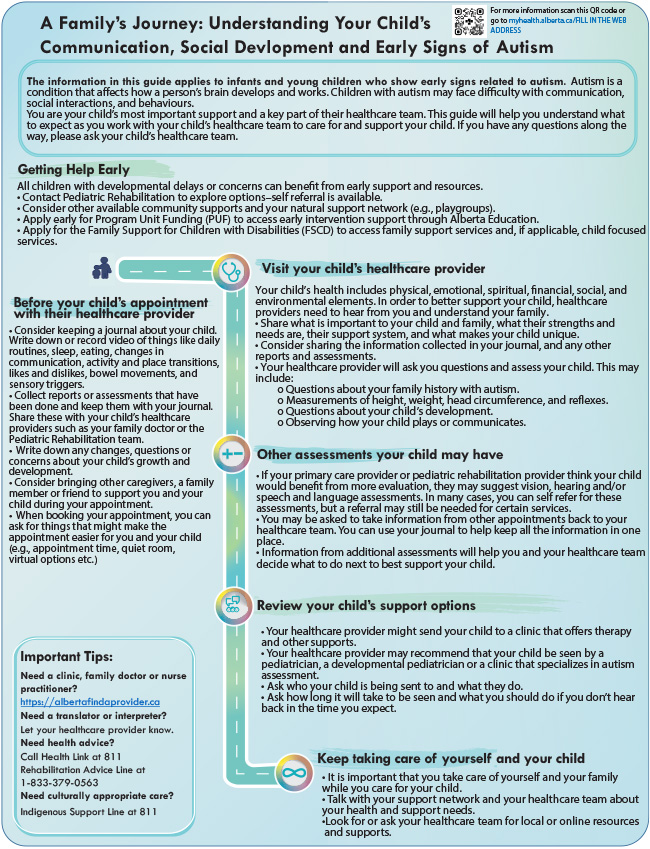
Autism Pathway
Download or print the
full patient pathway (PDF) and
summary (one-page PDF) to learn more about autism and what to expect as you care for and support your child.
Patient Pathway  Summary