This guide will help you to know what to expect as you work with your healthcare team to manage and treat osteoarthritis in the hand and wrist.
You will have your own unique journey with osteoarthritis. How you move through your journey, the number of visits with your healthcare team, the steps you will take, and the order you take them in will depend on your needs. You will make decisions in partnership with your healthcare team. Always talk with your healthcare team and follow their recommendations for your specific care.
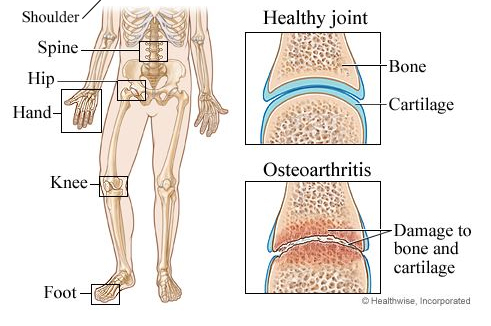
Arthritis is a condition that affects the joints (the areas where 2 bones meet). It can often cause pain, swelling, and stiffness in your joints. Arthritis is considered a chronic disease because it doesn’t go away and a progressive disease because it can get worse over time.
There are different types of arthritis and a person can have more than one type of arthritis.
Osteoarthritis is the most common type of arthritis. It happens when cartilage that protects your joints breaks down faster than your body can replace it. Cartilage is the tough elastic material that covers and protects the ends of your bones to allow for smooth movement. When the cartilage breaks down, the bones rub together and start to damage the joint. This damage can cause pain, swelling, and stiffness.
Hand and wrist osteoarthritis
Hands and wrists are among the most common joints affected by osteoarthritis. Although osteoarthritis in the hand and wrist impacts people differently, common symptoms include pain, tenderness, and loss of function, which means you can no longer do all the things you used to do with your hands.
Osteoarthritis in the hands and wrists is most common in the:
- index and middle fingers
- joints closest to your fingernail, called the distal interphalangeal (DIP) joints
- joints in the middle of your fingers, called the proximal interphalangeal (PIP) joints
- joint where your thumb meets your wrist, called the carpometacarpal (CMC) joint
- small bones in your wrist (the most common type of osteoarthritis in the wrist is called scaphoid lunate advanced collapse, or SLAC wrist)
Things that can increase your chance of getting hand and wrist osteoarthritis include:
- having a previous injury like a fracture, break, or dislocation
- doing everyday movements that put stress on your joints
- having a parent or sibling who has osteoarthritis of the hand and wrist
Hand and wrist osteoarthritis also becomes more common as you get older and is also more common in females.
Whole-person health
The whole-person health approach will help you and your healthcare team better manage your health condition.
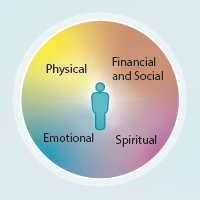
Whole-person health draws from the teachings of the medicine wheel. It means thinking about all parts of your health and wellness:
- physical
- finance and social
- spiritual
- emotional
These parts are all connected and impact each other. It’s important to be aware of your personal needs in each part and to share that information with your healthcare team. Your healthcare team needs to understand who you are and what matters to you.
Here are some examples of things you may want to talk about with your healthcare provider:
- “Opening jars is hard.” (physical)
- “I’m not sure how I will pay for the splints or assistive devices I need.” (financial and social)
- “I’m a believer of natural healing. Are there any natural treatments I can try?” (spiritual)
- “I do not like how my hands look.” (emotional)
Support and resources
- If you need a family doctor or clinic accepting new patients near you, visit
Alberta Find a Provider.
- If you need a translator, let your healthcare provider know.
- If you need health advice any time, day or night, call Health Link at 811.
- If you need to find programs and services in your community, call or text 211 or visit
211 Alberta.
For more information about hand and wrist osteoarthritis, see:
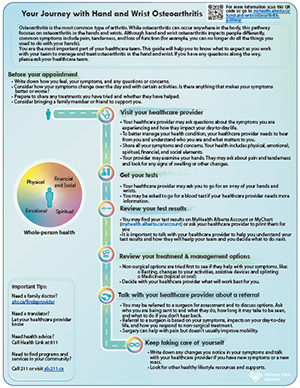
Hand and Wrist Osteoarthritis Pathway
Download or print the
full patient pathway (PDF) and
summary (one-page PDF) to learn more about how to manage and treat osteoarthritis in the hand and wrist.
Patient Pathway  Summary