Getting ready for appointments
To get ready for your appointment with your healthcare provider:
- Write down how you feel, your symptoms, how long symptoms last, what makes your symptoms better or worse, and any concerns you have. Are your symptoms worse at a certain time of day or with certain activities? Use a
symptom tracker (PDF) to help you remember information about your symptoms.
- Make a list of your questions and concerns, including how your symptoms affect how you do tasks and activities. When you’re done, mark the things that are most important to you.
- Make a list of the prescription and non-prescription (over the counter) medicines you use, including any vitamins, herbs, and supplements.
- Ask someone you trust to go with you to your appointment. They can help you ask questions, write down instructions, and remember explanations.
- Bring a pen and paper and plan to write notes during the visit. Or you can record the conversation using your phone or an app like the Alberta Health Services
My Care Conversations app.
Symptoms
Although osteoarthritis in the hand and wrist impacts people differently, common symptoms include:
- Stiff joints, especially when you first wake up. The stiffness usually lasts less than 1 hour but often returns at the end of the day or after activity.
- Pain that lasts longer than 3 months (chronic pain). This pain often occurs during or after activity or exercise and usually improves with rest. The pain is usually described as dull or burning, but there can also be other types of pain, like sharp pain, during certain activities.
- Being unable to do all the things you used to do with your hands (loss of function) because it is hard to bend your joints and make a full fist due to pain and stiffness.
- Weak hand and wrists.
- Cracking, creaking, or crunching when you move your hand and wrists, called crepitus.
- Changes in how your hands look. You may have firm, bony bumps at your finger joints (called Heberden’s nodes or Bouchard’s nodes depending on the joint) and at the base of the thumb. Your fingers may become crooked and stiff.
- If the arthritis occurs at the joint closest to the fingernail, a small cyst called a mucous cyst may develop. If the cyst is opening or you notice signs of infection, contact your healthcare provider.
- Fatigue, as it can take more energy to do things when you have pain and stiffness.
Swelling is less common with hand and wrist osteoarthritis.
Some people experience a lot of symptoms and joint changes while others do not. Some days, you may not experience any symptoms. Other days, you may find that your symptoms make it hard for you to do things you could do very easily before, like doing up buttons and zippers, opening cans, turning the key in the car ignition, using clippers and scissors, holding a pen, and brushing your teeth.
You may notice different symptoms or types of pain depending on the joints impacted by osteoarthritis. For example, with osteoarthritis of the joint at the base of your thumb, the pain and stiffness are most noticeable when you pinch or grip objects or when you do twisting motions, like opening a jar.
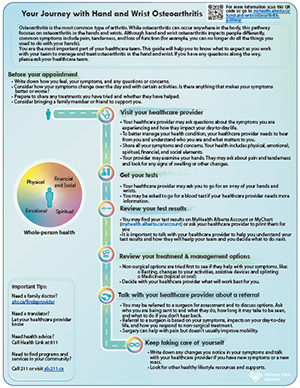
Hand and Wrist Osteoarthritis Pathway
Download or print the
full patient pathway (PDF) and
summary (one-page PDF) to learn more about how to manage and treat osteoarthritis in the hand and wrist.
Patient Pathway  Summary