Although there is no cure for hand and wrist osteoarthritis, there are many things you can try that can help you manage your symptoms.
Protect your joints with safe hand and wrist movements
- Spread the load and use your stronger joints.
- Use 2 hands when handling heavier items. For example, when you are pouring milk from a jug, use one hand to hold the handle of the jug and put your other hand underneath the milk jug.
- Avoid using the painful joint and use your larger joints and muscles to do things. For example, carry grocery bags on your arm towards your elbow instead of in your hands. Or use an over-the-shoulder bag instead of a handbag.
- Avoid gripping tightly and avoid gripping for long periods.
- Choose items, like cutlery, with bigger handles or use padding or grips to make handles bigger. You can also use padding or grips to make things easier to hold, like a pen grip that helps you hold a pen more gently.
- Stretch your hands gently and regularly during tasks where you are gripping, like knitting and writing.
- Take frequent breaks from repetitive activities like typing, gardening, or hammering, and stretch your hands and wrists.
- Use less effort.
- Use tools to help you with daily tasks, like jar and bottle openers, doorknob extenders, or Velcro fasteners (instead of buttons and laces).
- Think about ways to make tasks easier on your hands and wrists, like using lighter items (like lighter dishes), using electric tools rather than manual ones, or using a backpack or shopping cart to help you do your shopping so that you can avoid carrying heavy bags with your hands.
- If your joints hurt when you do an activity, try a different way to do things. For example, when you are quilting, use a sewing machine instead of hand quilting.
- Avoid positions that hurt.
- Keep your hands and wrists in a neutral position by using items like an ergonomic computer mouse and kitchen and gardening equipment with modified handles.
- Keep your hand and wrist joints in a stable position.
- When carrying and gripping objects, keep your wrist straight and your fingers in line with your wrists.
- Avoid activities that require your wrists to be bent for long periods.
Supportive therapies
- Heat (for example, a hot pack or a warm bath) and cold (for example, an ice pack) can help make your joints feel better. Learn more about using heat and cold therapies.
- Splints can be used to stabilize painful joints. Ask your healthcare provider what type of splint you need and how you should use it. You may be given a prescription for a specific splint. It’s important to understand what your splint is meant to do and how to wear it. Splints are only meant to be worn for certain tasks and you should not wear one all of the time. Remove your splint several times a day so you can move your joints and care for your skin.
- Exercise your hands and wrists. It can be hard to think about exercising a joint when you are in pain, but moving your joint is important to keep it working well. Talk with your healthcare team before you start an exercise program or activity, or if you have any challenges along the way. You can also call the Rehabilitation Advice Line at 1-833-379-0563 or call Health Link at 811 if you need any extra support.
- Talk with your healthcare provider to see if a hand therapist can help you change your activities or find the right splint. There may be costs associated with hand therapy, so check to see if you have private insurance that may help cover the cost.
- Acupuncture may provide some relief for some people, but the evidence is mixed.
Medicines
Pain medicines won’t make all of your symptoms go away. The goal when using pain medicine is to lower your pain level so that you can be more comfortable, move better, and do the things you enjoy and need to do.
Your healthcare provider might recommend:
- Non-steroidal anti-inflammatory (NSAIDs) creams or gels, like diclofenac gel, that you put on your skin. These are often the first medicines that are recommended since there are fewer side effects.
- Oral (pill form) NSAIDs, like ibuprofen and naproxen. You should only use these medicines for a short time and should avoid using them if you have certain medical conditions. Talk with your healthcare provider before taking this type of medicine if you have other medical conditions.
Always take medicines as directed. Talk with your healthcare provider if you have any questions about medicines.
There are many medicines and substances that have little or no evidence to support their use for osteoarthritis. Find a list in Your Journey with Hand and Wrist Osteoarthritis.
Surgery
Surgery may be considered when medicines and other therapies are not enough to manage pain or if the osteoarthritis is severely impacting your daily activities. Surgery for hand and wrist osteoarthritis is done to help with pain. It doesn’t usually improve how your joints move.
The time it takes to recover from surgery and what you need to do during the recovery period depends on the surgery that was done and on your specific situation.
Symptom management plan
A symptom management plan can be a useful tool to track your symptoms and whether the things you are trying as part of your care plan are helping. Find an example of a symptom management plan in Your Journey with Hand and Wrist Osteoarthritis. Review your plan with your healthcare provider at every visit and make changes as needed.
You can also work with your healthcare team to find resources in your community to learn about your osteoarthritis and to decide on a care plan that will work best for you.
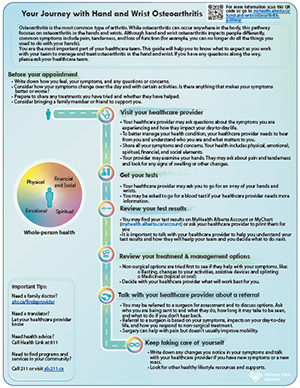
Hand and Wrist Osteoarthritis Pathway
Download or print the
full patient pathway (PDF) and
summary (one-page PDF) to learn more about how to manage and treat osteoarthritis in the hand and wrist.
Patient Pathway  Summary