The goal of treating obstructive sleep apnea (OSA) is to reduce symptoms, improve quality of life, and prevent serious health problems. Your healthcare provider may recommend that you make some changes to your lifestyle to manage your OSA. These may include changes to what you eat, your activity level, sleep position, and alcohol intake.
Your healthcare team may discuss the importance of driving safely with OSA and symptoms of excessive sleepiness.
Continuous positive airway pressure (CPAP)
CPAP therapy is a common and often effective treatment for sleep apnea. However, not all people with OSA need CPAP. For more information about CPAP see:
CPAP therapy for obstructive sleep apnea.
If you do need a CPAP machine, someone from your healthcare team will help guide you to the resources and supports you need.
Customized oral appliance
For patients with moderate or severe OSA, a
customized oral appliance may be an option for treatment. These devices work by gently pushing your lower jaw forward while you sleep. This helps to
open your airway, allowing better airflow, and reducing the chances of airway blockage.
A certified
sleep dentist who has experience fitting these devices will make sure it is customized to fit comfortably in your mouth and effectively shifts your lower jaw. It’s important not to use over-the-counter oral devices, as they have not been proven effective.
You will need to wear the device every night to help reduce breathing problems during sleep.
Surgery
Surgery may be an option for some people who have moderate or severe OSA. There are more than one surgical treatment options available. Some people may need a surgery to remove enlarged tissue that may block the throat and cause sleep apnea, while others may require jaw surgery. Surgery may be considered for some people who cannot tolerate using a CPAP machine or an oral appliance.
*Note: Not all treatments for OSA are covered by the Alberta Health Care Insurance Plan.
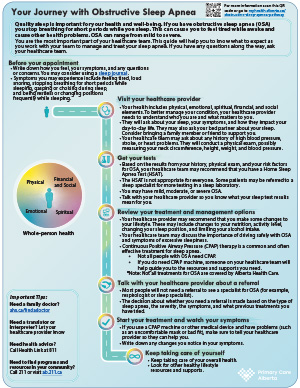
Obstructive Sleep Apnea Pathway
Download or print the
full patient pathway (PDF) and
summary (one-page PDF) to learn more about how to manage and treat obstructive sleep apnea.
Patient Pathway  Summary