Your healthcare provider will ask you about your health. To better manage your obstructive sleep apnea (OSA), your healthcare provider needs to understand what matters to you. They will ask about your sleep, your symptoms, and how they affect your day-to-day life. They may also ask your bed partner, if you have one, about your sleep. Consider bringing a family member or friend for support.
Your healthcare team will do a physical exam, possibly measuring your neck circumference, height, weight, and blood pressure.
Talk to your healthcare team about:
- symptoms that you have noticed and when you first started to notice them
- what impact sleep apnea is having on things that are important to you, like your job, hobbies and interests, and relationships
If you feel very sleepy during the day or if your job requires you to stay alert (like driving or operating heavy machinery), your healthcare provider will talk to you about driving safety. Sleep apnea can make you very tired, and this can be dangerous when you're on the road. It's important to take steps to keep yourself and others safe while driving.
Other things to tell your healthcare provider
You are the most important part of your healthcare team. Tell your healthcare provider about the impact the obstructive sleep apnea is having on the things that are important to you, like your job, hobbies and interests, and relationships.
Making the most of your appointment
If you don’t understand what your healthcare team is telling you, let them know right away. Be open and honest. You might say:
- “It sounded like you said that I should… Did I understand that correctly?”
- “Can you show me a picture or model to help me understand?”
Learn more about working with your healthcare team and making the most of your appointment.
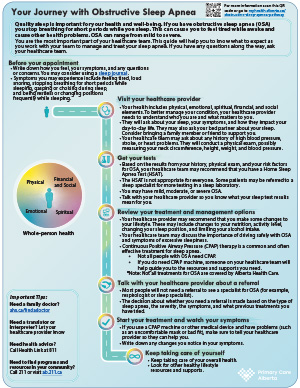
Obstructive Sleep Apnea Pathway
Download or print the
full patient pathway (PDF) and
summary (one-page PDF) to learn more about how to manage and treat obstructive sleep apnea.
Patient Pathway  Summary