As you try different treatment options, remember that if something doesn't work the way you thought it would, or if there are side effects you are struggling with, talk with your healthcare provider to find what will work for you.
Tips for taking iron supplement pills
If you are taking iron supplement pills, take them for as long as your healthcare provider tells you to. You may feel better after a few weeks of taking iron supplement pills, but don't stop taking the pills. You'll need to keep taking them for several months to build up the iron in your body.
To use iron supplement pills safely and effectively:
- If you miss taking your iron supplement pill, do not take a double dose.
- Vitamin C may help your body absorb the iron. Try taking your pill with a glass of orange juice or with another food or drink that has vitamin C.
- Take iron on an empty stomach, if you can. Iron is absorbed best if you take it on an empty stomach. But in some people, iron supplement pills can cause problems such as stomach discomfort and constipation. If you're having stomach problems, you may need to take the pills with food.
- If your iron supplement pills make you feel too sick, talk to your healthcare provider or pharmacist. There may be another type or dose of iron supplement pill you can take.
- Keep iron supplement pills out of the reach of children. Iron poisoning can be very dangerous.
- Do not take your iron supplement pills within 2 hours of taking antacids or tetracycline.
- Do not take iron supplement pills with:
- tea, coffee, chocolate, and other food or beverages high in caffeine
- milk and other calcium-rich foods or supplements
- high-fibre foods, such as bran, whole grains, nuts, and raw green vegetables
- Do not stop taking iron without first talking to your healthcare provider.
- Do not take more iron than what your healthcare provider has prescribed or recommended.
A pharmacist is a great resource for information on the types of iron supplement pills.
If you are unable to take a pill, you can try liquid iron. Liquid iron can stain your teeth so it may help to mix the liquid iron with water or juice and drink it through a straw.
What to expect after using iron supplement pills
You may start to feel better in a few weeks, but you usually need to take iron supplement pills for at least 6 months. Some people may need iron for many years.
Your healthcare provider may order blood tests to check your progress.
Common side effects of iron supplement pills
Many people have some side effects when they first start using iron supplement pills. These side effects are usually mild and often improve over time.
You may notice:
- upset stomach or nausea
- stomach cramps or discomfort
- constipation
- diarrhea
- dark or black coloured poop (this is common and not harmful)
- metal-like taste in your mouth
If your side effects are mild, keep taking the iron and let your healthcare provider know at your next visit.
Call your healthcare provider if:
- your side effects are severe or not improving
- you have ongoing vomiting
- constipation becomes painful or severe
- you cannot tolerate the iron at all
- you are unsure how or when to take the iron
Your healthcare provider may adjust the dose, change the type of iron, or suggest another treatment option.
Intravenous (I.V.) iron infusions
An intravenous (I.V.) iron infusion is a way to get iron into your bloodstream. The iron is given through a small tube inserted into your vein.
Where you get your I.V. iron infusion will depend on why you need the I.V. iron. Infusions may be done at a healthcare facility or private clinic. There may be a cost for certain types of I.V. iron and for infusions done at private clinics. Check with your insurance provider and benefits about coverage that may be available to you.
I.V. iron infusions may take up to 2 hours or more depending on the type of infusion you are getting. Some types of iron are not provided by the clinic doing the infusion. Confirm with the infusion clinic if you need to get your iron from a pharmacy ahead of time to bring to the appointment.
During the infusion, if you feel any irritation or if you see your skin change colour around the I.V. site, notify the healthcare provider doing the infusion right away.
After the infusion, the healthcare team at the clinic will monitor you for a period of time.
Your healthcare provider may ask you to also take iron supplement pills even when you are getting I.V. iron infusions.
Watch your symptoms
Call your healthcare provider or Health Link at 811 if you have any concerns. You might feel like you don't want to bother your healthcare team, but no detail is too small to share.
If you notice any of the following, go to the emergency department or call 911 right away:
- heavy bleeding (bleeding that is flowing or continuous) from your rectum (bum), vagina, or nose
- severe chest pain that starts suddenly
- fainting
- rapid, shallow breathing
- weak or fast pulse
- confusion or severe, unexplained fatigue
Call Health Link at 811 or call your healthcare provider if you notice any of the following:
- soaking a high-protection menstrual product like a pad, tampon, or menstrual cup every hour for more than 2 hours
- passing large clots (larger than a loonie)
- feeling dizzy, weak, feverish, or having severe abdominal pain
- signs of infection, such as a fever or feeling generally unwell
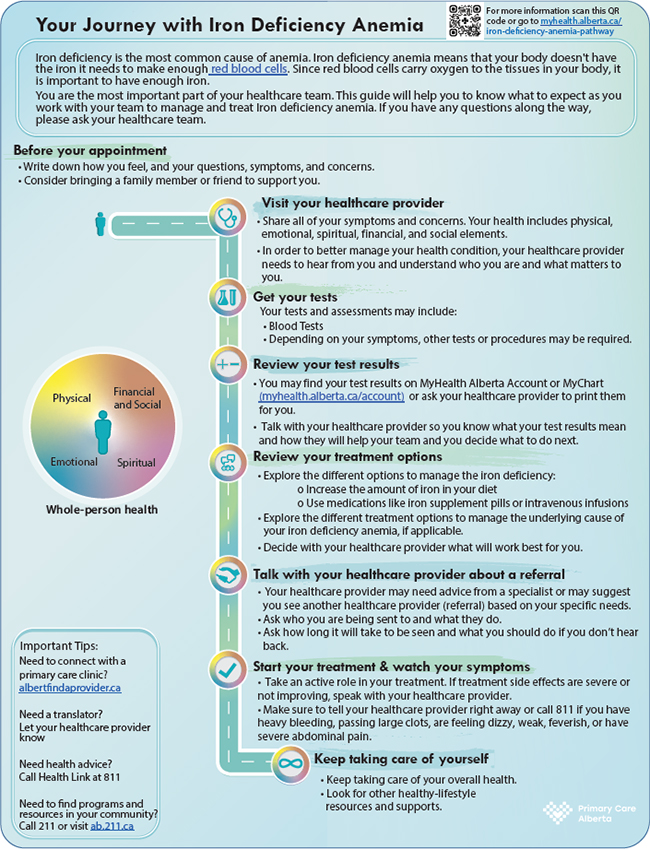
Iron Deficiency Anemia Pathway
Download or print the
full patient pathway (PDF) and
summary (one-page PDF) to learn more about how to manage and treat iron deficiency anemia.
Patient Pathway  Summary