If you think you have iron deficiency anemia, see your healthcare provider. They will try to find the cause of the anemia and treat that problem.
Do not try to treat yourself.
- Taking iron pills yourself could delay the diagnosis of a serious problem, such as a bleeding ulcer or colon cancer.
- If your anemia is not caused by iron deficiency, taking iron pills won't relieve the anemia. And it may cause you to have too much iron in your blood or have iron poisoning.
When you visit your healthcare provider, they may ask you questions about your health, daily habits, and medical history. This helps them understand what might be causing your symptoms.
Your healthcare provider will order tests to better understand what's going on and make sure that you are getting the right treatment. You will need to book an appointment at a laboratory to have your blood tests completed. Learn more about
getting your tests for iron deficiency anemia.
Other things to tell your healthcare provider
You are the most important part of your healthcare team. Tell your healthcare provider about the impact your symptoms are having on the things that are important to you, like your job, hobbies and interests, and relationships.
Making the most of your appointment
If you don't understand what your healthcare team is telling you, let them know right away. Be open and honest. You might say:
- "It sounded like you said that I should… Did I understand that correctly?"
- "Can you show me a picture or model to help me understand?"
Learn more about
working with your healthcare team and
making the most of your appointment.
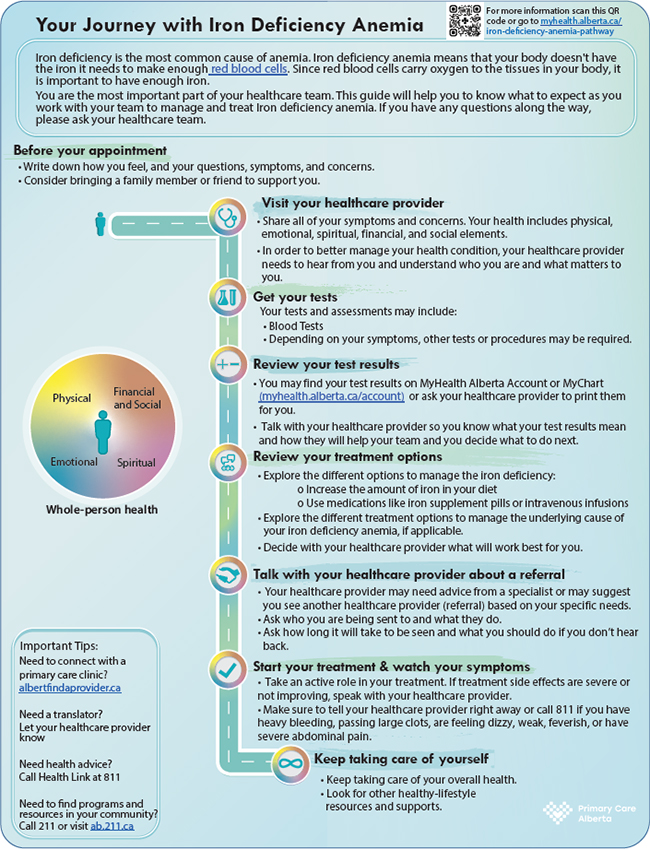
Iron Deficiency Anemia Pathway
Download or print the
full patient pathway (PDF) and
summary (one-page PDF) to learn more about how to manage and treat iron deficiency anemia.
Patient Pathway  Summary