Your healthcare provider may suggest blood tests to better understand what's going on and make sure that you are getting the right treatment. Tests may include:
-
Complete blood count (CBC) to give information about the kinds, size, and numbers of cells in your blood.
-
Ferritin test to show how much iron is stored in your body.
-
Iron tests to measure how much iron is in your blood and how well your body is using that iron.
It is possible to have more than one type of anemia at the same time. Your healthcare provider may suggest more blood tests.
Finding the cause of your low iron is important. In some people, the reason is clear. For example, anemia is common during pregnancy or in people who have heavy menstrual periods. If the cause is not clear, your healthcare provider may recommend more tests, like:
-
Tests to check your stomach or bowel to see if there is any bleeding inside your body. Your healthcare provider may recommend these tests even if you do not have stomach or bowel symptoms, especially if you are older. Some of these tests, like a gastroscopy,
endoscopy,
colonoscopy, and
sigmoidoscopy, use a small, flexible tube and camera to look at different parts of your body. In some cases, your healthcare provider may recommend a
CT scan of your abdomen (belly).
-
Blood tests for celiac disease. Sometimes a small sample of your bowel lining may also be taken to confirm a celiac disease diagnosis. This is called a biopsy.
-
Pelvic ultrasound. If you have heavy menstrual periods, your healthcare provider might order a
pelvic ultrasound.
Your healthcare provider will explain the reasons for any tests and help you understand what to expect.
Making an appointment
After your healthcare provider talks with you about which tests they recommend, you will need to
book an appointment at a laboratory. Your healthcare provider may give you a paper form (called a requisition) to take with you to the lab or they may send the requisition to the lab for you. Confirm with your healthcare provider whether you need a paper copy of the form.
To make sure you are ready for your lab appointment, ask your healthcare provider if you will need to fast (not eat), provide a urine (pee) sample, or provide a stool (poop) sample for any of your tests.
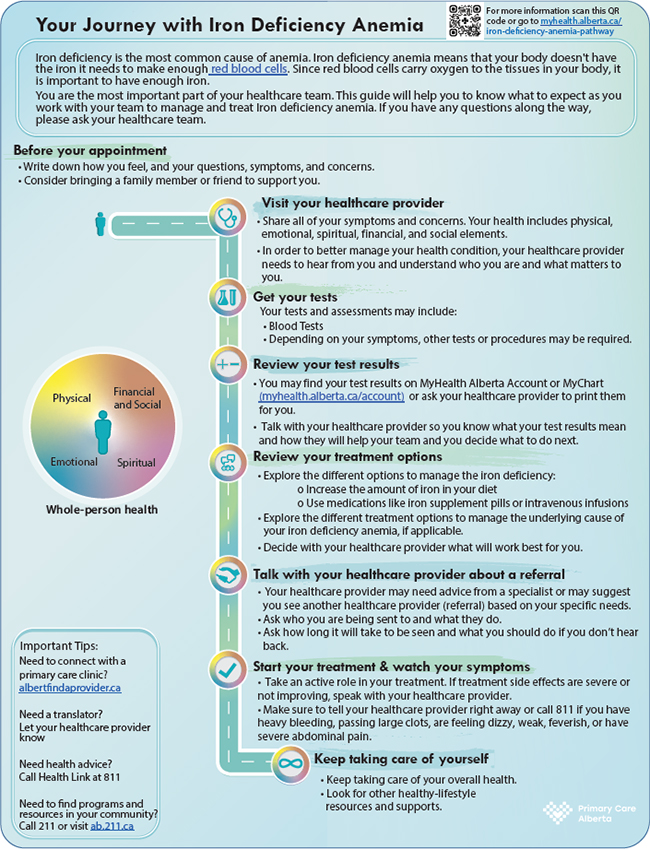
Iron Deficiency Anemia Pathway
Download or print the
full patient pathway (PDF) and
summary (one-page PDF) to learn more about how to manage and treat iron deficiency anemia.
Patient Pathway  Summary