Treating a urinary tract infection (UTI)
If needed, your healthcare provider will prescribe antibiotics to treat your urinary tract infection (UTI). Antibiotics are medicines used to kill bacteria, like those that cause UTIs. Your healthcare provider will prescribe the right antibiotic for you based on your situation and the kind of bacteria found in your urine. Make sure to take your antibiotic medicine exactly as prescribed and finish taking all your antibiotics, even if you start feeling better.
You do not need treatment if you don’t have symptoms of a UTI, unless you are pregnant, have multiple sclerosis, have a spinal cord injury, or will be getting a surgery of your urinary tract.
Getting treated with antibiotics when you don’t have symptoms of a UTI can do more harm than good. It can lead to antibiotic overuse, which can make antibiotics less effective and can cause side effects, including a serious gut infection.
Being prescribed antibiotics ahead of time (self-start treatment)
For some people with recurrent UTIs, your healthcare provider will give you a prescription for antibiotics ahead of time. If you develop symptoms of a UTI, you can start the antibiotic right away. This is called self-start treatment. Talk with your healthcare provider to see if this option is right for you.
Preventing recurrent UTIs
There are several options you can try to help prevent recurrent UTIs. Decide with your healthcare provider what will work best for you.
Drink enough water
- Try to drink 2 to 3 litres of water every day.
Urinate (pee) regularly
- Don’t hold in your urine. And empty your bladder fully when you have to urinate.
Vaginal estrogen
- If you have perimenopause or have entered menopause,
vaginal estrogen can help reduce recurrent UTIs.
Pelvic floor exercises
- Some people with recurrent UTIs might have a problem with their pelvic floor muscles which could make recurrent UTIs more common. Your healthcare provider may recommend being assessed by a pelvic floor physiotherapist to see if pelvic floor muscle training could help.
- Many people need help learning how to do pelvic floor muscle training properly. Seeing a pelvic floor physiotherapist is a great way to get the support you need.
Find pelvic floor physiotherapy resources near you, attend a
free pelvic health physiotherapy webinar, or call the Alberta Health Services Rehabilitation Advice Line at 1-833-379-0563 for help finding a clinic.
Cranberry products
- Cranberries are thought to help prevent recurrent UTIs because they contain a natural substance called proanthocyanidins (PACs). Cranberry products come in different forms, such as juice, tablets, and powder. It is not clear which type or dose works best for preventing recurrent UTIs.
- A common amount of proanthocyanidins (PACs) recommended for prevention is 36 to 72 mg of PACs per day. Cranberry products are not all made the same, and PAC amounts are not always listed on the label. In general, a reasonable option is 1 cup (8 oz) of cranberry juice once or twice a day, or 500 to 1,000 mg of cranberry tablets per day.
- If you choose to drink cranberry juice, look for unsweetened cranberry juice, not cranberry cocktail. Unsweetened juice has less sugar and more of the helpful PACs. Cranberry juice can be high in sugar and calories, so it may not be a good choice for everyone.
Methenamine hippurate
- Methenamine hippurate is a medicine that kills bacteria in your urine. One way it does this is by making your urine more acidic.
- In Canada, methenamine hippurate can be bought online or be custom-made by a pharmacist. This can make it more expensive to buy than some other medicines. Check with your benefits plan to learn if you are eligible for coverage.
- This medicine is not for everyone, such as people with kidney or liver problems, severe dehydration, or gout. Talk to your healthcare provider about whether this medicine is a good option for you.
- Methenamine hippurate should
not be combined with antibiotics (especially sulfa drugs) to prevent recurrent UTI.
Prevention approaches without clear evidence
Some prevention options do not have clear evidence to support their use, but they have a low risk of causing harm. Some people may want to try them to see if they help.
- Avoiding spermicides and spermicide-coated condoms. These can change the balance of healthy bacteria in the vagina. If you stop using spermicides and spermicide-coated condoms, consider other options for birth control and for preventing sexually transmitted infections, like using condoms that don’t have spermicides.
- Probiotics are healthy bacteria that help promote a healthy balance of good bacteria in the body.
Lactobacillus probiotics seem to be important in keeping the vagina and urinary tract healthy, but the best dose and route to take them isn’t clear.
- D-mannose is a natural sugar that is thought to stop bacteria from attaching to bladder cells. Because there isn’t clear evidence of it being effective, it isn’t clear what dose is best to take.
Antibiotic prophylaxis
Antibiotic prophylaxis means using antibiotics to help prevent recurrent UTIs when you don’t have an active UTI. Antibiotic prophylaxis comes with risks, so should only be considered if you are having many recurrent UTIs that are very bothersome and impacting your quality of life.
Non-antibiotic options should always be considered first.
Typically, you will try antibiotic prophylaxis for 6 to 12 months. You should continue using non-antibiotic strategies when on antibiotic prophylaxis.
If sex is a clear trigger for your recurrent UTIs, your healthcare provider may recommend you take a single dose of antibiotic right before or after having sex.
If you start to develop symptoms of a UTI while on antibiotic prophylaxis, tell your healthcare provider. They will order tests to confirm an active UTI and will order different antibiotics for you to take.
Hygiene
Recurrent UTIs are
not caused by poor hygiene. There is no clear association between recurrent UTIs and:
- peeing (urinating) habits before and after sex
- wiping direction
- urinating frequency
- douching
- using hot tubs
- using pantyhose or tights
- body mass index (BMI)
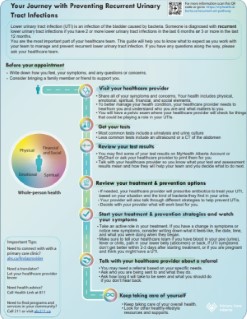
Recurrent Lower Urinary Tract Infection (UTI) Pathway
Download or print the
full patient pathway (PDF) and
summary (one-page PDF) to learn more about how to manage and treat GCA.
Patient Pathway  Summary