This guide will help you to know what to expect as you work with your healthcare team to manage your journey with perimenopause or menopause.
You will have your own unique journey with perimenopause and menopause. How you move through your journey, the number of visits with your healthcare team, the steps you will take, and the order you take them in will depend on your needs.
You will make decisions in partnership with your healthcare team. Always follow your healthcare team’s advice. Your healthcare providers understand that the symptoms you are experiencing may be hard to talk about, and they are there to support you.
What is perimenopause?
Perimenopause is the phase of life before menopause where your body starts to change. It usually begins in your mid 40s, but it can start earlier or later. Perimenopause can last 2 to 8 years.
Changes during perimenopause happen because your hormone levels, especially estrogen, start to go up and down. Up to 4 out of 5 people may experience a variety of symptoms and changes during perimenopause. Examples of
common symptoms include hot flashes, trouble sleeping, night sweats, fatigue, mood swings, and period changes.
Early in perimenopause, if your periods have been regular, you may notice that the length of time between your periods can vary by 7 or more days. You may or may not have symptoms during this time.
Later in perimenopause, you may go for 60 or more days without a period. You are more likely to have symptoms during this time.
What is menopause
Menopause begins when you haven’t had a period for 12 months in a row. Most people reach menopause between the ages of 45 and 55. Once you have entered menopause, you are no longer able to get pregnant naturally. Some people may experience premature menopause (menopause before the age of 40). Premature menopause may require different treatment than natural menopause.
Natural menopause happens when your body transitions to menopause without medical intervention. There are some medical treatments and surgeries that can affect how your ovaries work and may trigger the start of menopause. Menopause that is started by medical treatments or surgeries can be permanent or temporary. Talk to your healthcare provider to understand how a treatment or surgery may affect you.
As you transition into menopause, some of the symptoms of perimenopause may shift. Some symptoms may fade, some may stay the same, and others may become worse. Symptoms of menopause last for 7 years on average, but they can last much longer.
Whole person health
The whole-person health approach will help you and your healthcare team better manage your health condition.
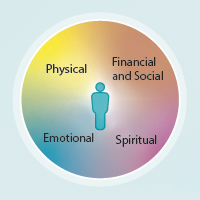
Whole-person health draws from the teachings of the medicine wheel. It means thinking about all parts of your health and wellness:
- physical
- financial and social
- emotional
- spiritual
These parts are all connected and impact each other. It’s important to be aware of your personal needs in each part and to share that information with your healthcare team. Your healthcare team needs to understand who you are and what matters to you. Here are some examples of things you may want to talk about with your healthcare provider:
- “Joint pain is making it hard for me to exercise.” (physical)
- “Incontinence products, like pads, are very expensive and I can’t afford them.” (financial and social)
- “It’s important that my religious practice of fasting is respected and brought into my care.” (spiritual)
- “I’m lonely and have no one to talk to.” (emotional)
Support and resources
- If you need a family doctor or clinic accepting new patients near you, visit
Alberta Find a Provider.
- If you need a translator, let your healthcare provider know.
- If you need health advice any time, day or night, call Health Link at 811.
- If you need to find programs and services in your community, call or text 211 or visit
211 Alberta.
For more information about perimenopause and menopause, see:
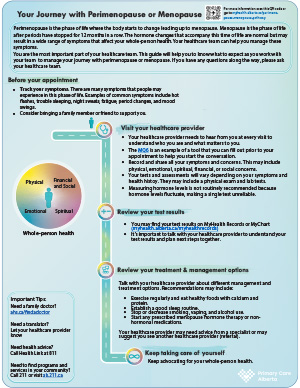
Perimenopause and Menopause Pathway
Download or print the
full patient pathway (PDF) and
summary (one-page PDF) to learn more about how to manage and treat perimenopause and menopause.
Patient Pathway  Summary