As you try different treatment options, remember that if something doesn’t work the way you thought it would, think about other options. Talk with your healthcare provider to find what will work for you.
Ask direct questions and make direct statements like:
- “These symptoms are affecting the quality of my life.”
- “I would like to talk about treatment options, including menopause hormone therapy.”
- “Are there non-hormonal medicines that can help me with my symptoms.”
- “I would like to have a more in-depth conversation about how menopause is affecting me. What are my options to make this happen?”
Watch your symptoms
Watching your symptoms is important. Call your healthcare provider or Health Link at 811 if you have any concerns. You might feel like you don’t want to bother your healthcare team, but no detail is too small to share. If it matters to you, it will matter to your healthcare team.
Go to the emergency department or call 911 if you notice:
- continuous or flowing vaginal bleeding
Call Health Link at 811 or call your healthcare provider if you notice any of the following:
- soaking a high-protection product like a pad, tampon, or menstrual cup every hour for more than 2 hours
- passing large clots (larger than a loonie)
- feeling dizzy, weak, feverish, or having severe abdominal pain
- signs of infection, such as a fever or feeling generally unwell
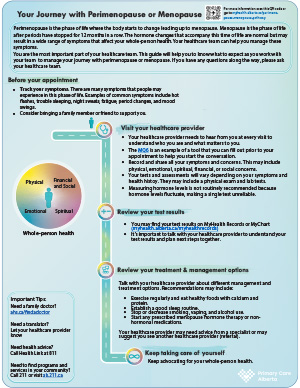
Perimenopause and Menopause Pathway
Download or print the
full patient pathway (PDF) and
summary (one-page PDF) to learn more about how to manage and treat perimenopause and menopause.
Patient Pathway  Summary