Your healthcare provider may ask if you are interested in taking medicines to help with your symptoms. Asking the following questions can help you make an informed decision about your different treatment options and decide which ones will work best for you:
- “What are the advantages and disadvantages of each treatment option?”
- “Can I use any of these treatment options together?”
- “How will this treatment make me feel? Will it have side effects?”
- “What results can I expect?”
- “Are there free or low-cost options?”
Menopause hormone therapy
Menopause hormone therapy are prescription medicines that replace the hormones produced in the ovaries, such as estrogen and progesterone. This used to be called hormone replacement therapy (HRT) but menopause hormone therapy is the more accurate term.
Menopause hormone therapy can be used to help manage hot flashes, night sweats, and issues with your vulva, vagina, or bladder.
Menopause hormone therapy may also be considered to prevent bone loss if you are at higher risk for osteoporosis.
It is important that your healthcare provider knows your past medical history as there are certain conditions where hormone therapy should not be used.
Menopause hormone therapy can be systemic or local:
-
Systemic menopause hormone therapy is medicine that goes into your blood stream and travels throughout your body. These medicines are usually pills, patches, or gels. Systemic menopause hormone therapy is safest if you start taking the medicine early in menopause. The risks of systemic menopause hormone therapy vary depending on when you start the medicine, the type of medicine, and how long you take it for. These medicines should be started before the age of 60 or within 10 years of your final period. Talk with your healthcare provider about the best dose and type of medicine for you.
Menopause hormone therapy is a safe and effective treatment if you start the medicine before the age of 60 or within 10 years of your last period. If you are older and taking systemic menopause hormone therapy, you may increase your risk of stroke, heart attacks, blood clots, and dementia.
The risks of taking systemic menopause hormone therapy may outweigh the benefits if you have a history of certain health conditions such as breast cancer, heart disease, or severe liver disease. Talk with your healthcare team about what is best for you.
- Local menopause hormone therapy is medicine that is applied to your vagina and only affects that area. Since very little of the medicine goes into the blood stream, there are fewer risks and side effects with local menopause hormone therapy compared to systemic therapy. The most common type of local menopause hormone therapy is vaginal estrogen, which is very safe and can be started at any age. Vaginal estrogen is used to help manage genital and urinary symptoms. It can be used as a cream, vaginal insert, capsule (called an ovule), or ring inserted into the vagina. Talk with your pharmacist about how to use these products.
There is no set time limit for using menopause hormone therapy. Talk with your healthcare provider about when is the best time to stop taking these medicines based on your goals and risk factors.
For more information on types of menopause hormone therapy and the risks and benefits, visit:
Compounded bioidentical hormone therapy
Compounded bioidentical hormone therapy medicines are not approved by Health Canada. Compounded means that a medicine has been customized by mixing, combining, or altering ingredients into a specific combination that isn’t usually made commercially. Compounded bioidentical hormone therapy medicines present safety concerns because they are not regulated and there are no uniform standards for making these products.
The word “bioidentical” or “body identical” are words used by businesses trying to market their compounded products. There is no evidence to show that this type of hormone therapy is safe or effective for most people.
There are bioidentical hormones that are not compounded and that are safe to use. Talk with your healthcare provider if you are considering these products.
Non-hormonal prescription medicine
Some people cannot use menopause hormone therapy because of a personal preference or because it might increase the risk of harm due to other health conditions or medicines (this is called a contraindication). Your healthcare provider may suggest other medicines to help manage your symptoms. Ask your healthcare provider about the effectiveness of the medicines and any side effects.
Natural health products and supplements
Some people believe that certain herbal products like black cohosh, red clover, evening primrose oil, and St. John’s wort will help with menopause symptoms. Many products that claim to help with menopause symptoms have not been approved by Health Canada.
Natural does not mean safe. It is important to talk with your healthcare provider if you are considering these products as they may be harmful if you have certain health conditions or take other medicines.
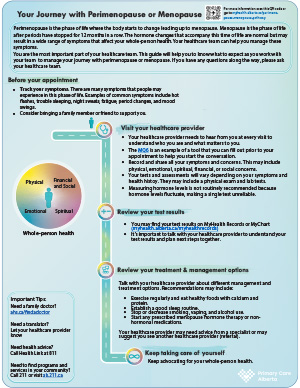
Perimenopause and Menopause Pathway
Download or print the
full patient pathway (PDF) and
summary (one-page PDF) to learn more about how to manage and treat perimenopause and menopause.
Patient Pathway  Summary